"What made revenues spike last week?"
ClarityQ answers open-ended questions across any data, like where product meets finance, without compromising context or accuracy. It catalogs billions of tables, metrics, and events into a unified contextual layer in days, then delivers answers with visuals, insights, and a clear action plan.


ClarityQ has been a real game-changer for us! It lets our entire gaming team work with data at scale. We’re querying billions of events and dozens of tables, with in-depth analysis delivered in seconds. It empowers both analysts and game owners with 5× greater efficiency and real data superpowers - saving countless hours of analysis and enabling faster, better decisions.

Co-founder & COO, CrazyLabs


ClarityQ became a critical decision layer for us, turning complex behavioral data into clear actions. We identified friction points in our onboarding and loyalty mechanics, which led us to remove low-impact features and focus on real revenue growth.

Director of Product, Zaffic


ClarityQ lets our Marketing and Product teams get answers in minutes instead of hours. We used to juggle Firebase, GA, AdMob, Adjust - now everything lives in one place. Our analysis is easily 10x faster, saving us hours every time. But the real game-changer is the insights we wouldn't have found on our own - things we didn't even know to look for.

CEO, Appgeneration


ClarityQ (or "Clara" as we refer to it) functions as a co-pilot analyst providing me and other stakeholders (including users who are resistant to use the standard reporting tools available in the company) with business insights via very friendly and convenient interface and visual outputs.

Head of Business Analysis, Spiral Interactive

Thanks to the ClarityQ Agent and strong team support, we found the perfect analysis wingman. It has significantly sped up our deep-dive analyses, is expected to cut analysis time by at least half and has freed up time to focus more on strategic work.

Data Analyst, Softonic









Go from messy tables to meaningful discovery in just days. Ask any question, drill into any metric, and pivot between dimensions to generate in-depth analyses and build a comprehensive understanding of root causes. Turn a single conversation into a validated set of insights that your team can align and act on, fast.
ClarityQ’s agent is built for complex analytics, autonomously managing the entire journey: planning, reasoning, and validating every answer to ensure every insight and visualization is reliable and grounded in your specific data.
ClarityQ automatically structures your data semantics, updates them, and flags gaps - building on your existing BI definitions and business logic. It applies guardrails to ensure every answer is grounded in your specific context, and stops for clarification when needed rather than hallucinating or guessing - delivering transparent, well-grounded results you can trust, always.
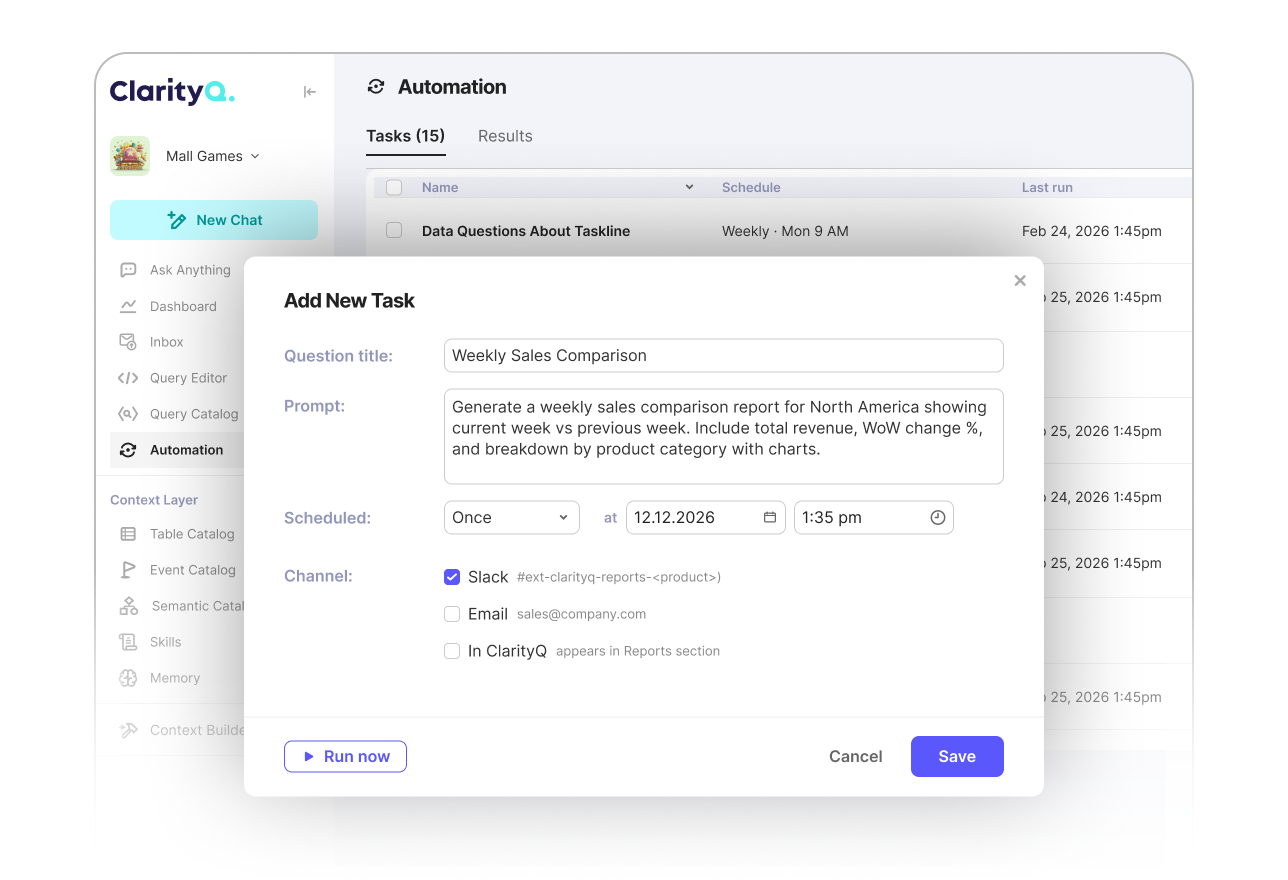
Schedule any question to run on its own - daily, weekly, or monthly. Set it once, and ClarityQ delivers fresh results automatically via email, Slack, or the dedicated Results tab. Create an automated task straight from the chat or from the Automations tab, so insights keep flowing even when you're not in the room.
ClarityQ has been a real game-changer for us! It lets our entire gaming team work with data at scale. We’re querying billions of events and dozens of tables, with in-depth analysis delivered in seconds. It empowers both analysts and game owners with 5× greater efficiency and real data superpowers - saving countless hours of analysis and enabling faster, better decisions.
Co-founder & COO, CrazyLabs
ClarityQ became a critical decision layer for us, turning complex behavioral data into clear actions. We identified friction points in our onboarding and loyalty mechanics, which led us to remove low-impact features and focus on real revenue growth.
Director of Product, Zaffic
ClarityQ lets our Marketing and Product teams get answers in minutes instead of hours. We used to juggle Firebase, GA, AdMob, Adjust - now everything lives in one place. Our analysis is easily 10x faster, saving us hours every time. But the real game-changer is the insights we wouldn't have found on our own - things we didn't even know to look for.
CEO, Appgeneration
ClarityQ (or "Clara" as we refer to it) functions as a co-pilot analyst providing me and other stakeholders (including users who are resistant to use the standard reporting tools available in the company) with business insights via very friendly and convenient interface and visual outputs.
Head of Business Analysis, Spiral Interactive
Thanks to the ClarityQ Agent and strong team support, we found the perfect analysis wingman. It has significantly sped up our deep-dive analyses, is expected to cut analysis time by at least half and has freed up time to focus more on strategic work.
Data Analyst, Softonic
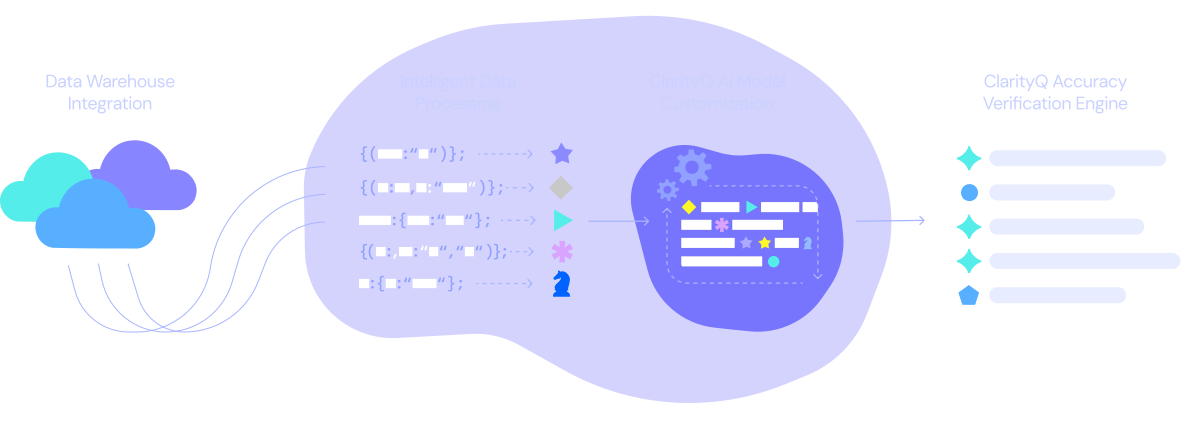

Context-Driven data streamlining & mapping
Our proprietary GenAI-based tech performs entity resolution, context mapping, and schema change analysis to create a comprehensive Event Catalog enriched with useful, automatically-created metadata.
Company-specific AI model
Using company-specific customizations to the model, including example-based learning, schema linking, and automatic dataset creation ensures an enhanced, tailor-made model performance.
Accuracy as a key to success
For robust quality assurance of its accuracy, ClarityQ employs a range of advanced, academically-supported mechanisms for ensuring the accuracy of its outputs, incorporating various verification and validation techniques as well as ensemble methods for quality assurance.

Connect your data
Use a secure, guided wizard to connect ClarityQ to your data warehouse using a service account or your preferred auth method, and optionally connect BI tools and semantic layers
Read-only access to your warehouse
Additional integrations are optional and help enrich definitions and accelerate Context Layer readiness

Review and approve your Context Layer
ClarityQ generates business definitions, metrics, and contextual catalogs - you review, adjust, and approve what becomes your source of truth.

Start using ClarityQ
Start asking questions and get answers - make data-driven decisions faster than ever.