Most conversations about AI analytics focus on the model or on the semantic (context) layer, while the layer in the middle rarely gets a name.
That layer is the harness, a term that's everywhere in AI right now but rarely explained in the context of data and analysis.
The harness is the software that decides what the model sees before it writes a single line of SQL, and it orchestrates and oversees the model's actions.
Without a harness, the agent is running blind. With a good one, it gets exactly what it needs and nothing else.
Three main value areas follow from that, and this article works through each of them:
These are three of many, and we'll cover the others in later posts.
The term comes from the wider world of AI agents, where LangChain's definition is the simplest one around: an agent is a model plus a harness. The model supplies the intelligence, and the harness is everything built around it that makes that intelligence useful. Different teams draw the boundary differently, but they agree on the core idea, and in LangChain's own tests, changing only the harness, with the same model underneath, raised its score on a coding benchmark by almost 14 points.
For an analytics agent, the part of the harness that matters most is what it does with context. A model has a limited working memory, and every question has to fit into it, so something has to decide what gets loaded for each question. LangChain's write-up on context engineering breaks that decision into four jobs: saving what the agent learns somewhere it can find again later, loading only the pieces a given question needs, trimming what's loaded down to what matters, and keeping separate tasks from sharing one crowded workspace.
In an analytics system, the harness is where those four jobs live. It's sometimes called the retrieval layer or the efficiency layer, and it has a job on the way in and a job on the way out:
A harness is only as good as the engineering behind it, which is exactly where agentic analytics solutions differ.
Let's assume the best case: your context layer is in perfect shape, and every definition is correct, audited, versioned and complete.
Then somebody asks:
"What was ARPU in the US last week, excluding test accounts?"
Every piece needed to answer is in the layer, so the only question is how much the agent has to read to find it. Without a harness, it works like someone handed a filing cabinet and told to have a look:
That's six steps, with eleven tool calls behind them.
The output may well come out correct, but it cost many times what it needed to, it took far longer than it should have, and the context window is now full of data the question never needed. That can hurt the accuracy of every follow-up question in the same chat.
With a harness, the model never has to run those searches, because before it generates anything it receives exactly what it needs. Conceptually, it looks something like this:
TABLE      fact_daily_revenue  (source of truth for revenue metrics)
FILTER     country_code = 'US'  (geo is deprecated)
METRIC     ARPU = net_revenue / active_users, net of refunds, v4
RULE       exclude is_test_account = true  (synced from qa_exclusion_list)
WINDOW     last week = 2026-10-26 to 2026-11-01  (Mon-Sun, company standard)
EXAMPLE    [one prior ARPU query that ran clean]
That's five lines and one example, and each line replaces a search the agent would otherwise have run: the deprecated column is already excluded, test accounts are already turned into a filter instead of a list to hunt for, and the meaning of "last week" is settled before the model starts.
None of this looks sophisticated, and that's exactly the point, because what makes it work is a governed context layer worth retrieving from, combined with a harness built for accuracy and efficiency.
When an agent gets something wrong, the instinct is to give it more: a bigger window, more schema, more examples. That instinct is backwards, and there's now a good amount of published work showing it.
The most direct test. Chroma ran a study of 18 models from Anthropic, OpenAI, Google and Alibaba, published in July 2025.
One experiment used LongMemEval, a set of conversational questions, and asked each question two ways: once with the full input of about 113,000 tokens, and once with a focused input of about 300 tokens containing only the relevant part.
Every model scored significantly higher on the focused version.
That result is the whole harness argument in one line. The model, the task and the underlying information were all the same, and the only difference was whether the relevant part was found before the model saw it or left for the model to find on its own.
A second experiment in the same study shows the same pattern from another angle:
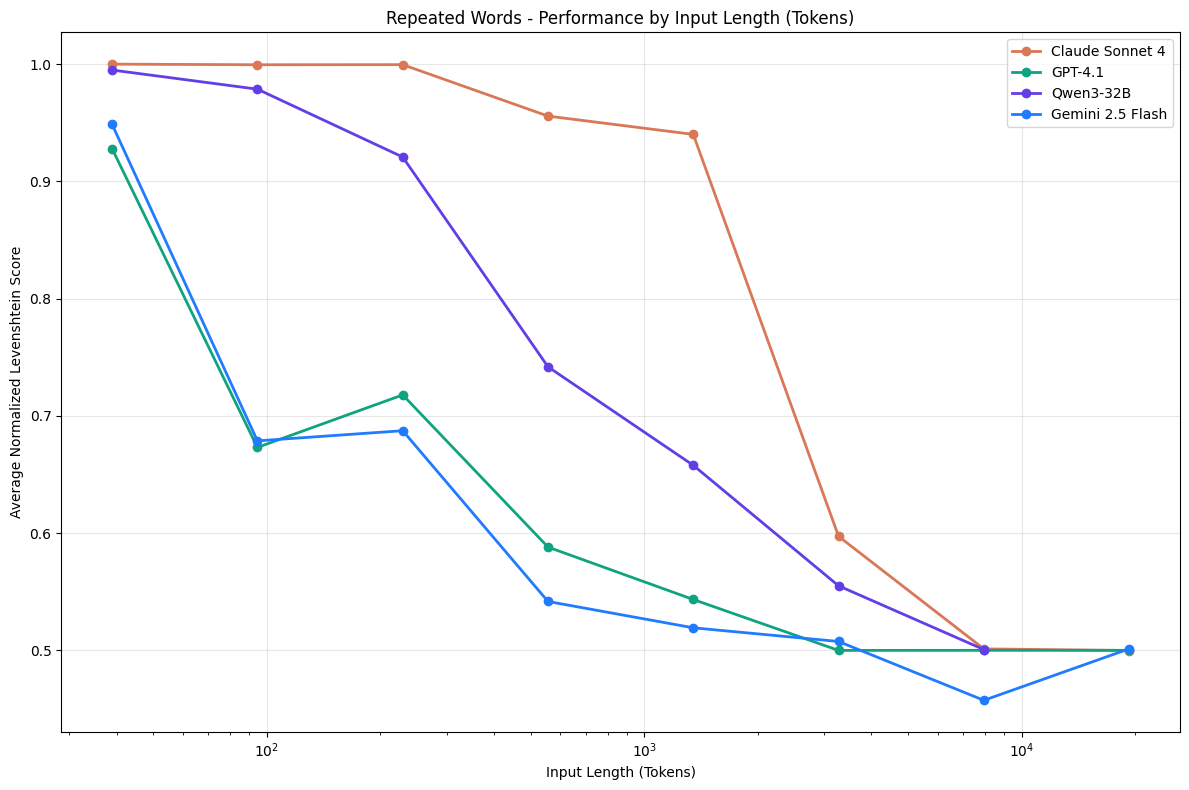
It gets stranger. In the same study, shuffling the surrounding text hurt performance less than leaving it in a coherent order. One plausible reading is that coherent text gives the model a convincing wrong trail to follow.
It also undermines the idea that you can fix retrieval by adding more surrounding material just so the model has "more context."
Because the harness sits in the path of every request, from question to answer, it is the component positioned to see how each task actually went:
None of that is visible from inside the context layer, because all of it happens while the task runs. The layer holds definitions but can't see how they performed, so it's passive by design.
That makes the harness the input to every improvement loop you might want. Here is what it records, and what each record makes possible:
Without that record, you can't see how your data agents are performing and you can't improve them automatically, which leaves you with something like a passive catalog with good intentions.
This also explains an architectural constraint that is easy to dismiss:
A context layer that sits outside the agent's runtime can store, version and serve definitions perfectly well. What it can't do on its own is see that one of them was corrected, contested, missing or guessed at, because that happens inside the agent's runtime. If you run a separate semantic layer, the harness has to stay in sync with it and feed those signals back. Otherwise you give up the automation before you start.
There are four tests, listed in order of how quickly they settle the question. Each one asks for something the system can show you, not something the agent can tell you, because an agent will answer any of these questions confidently whether or not the record exists.
For a question you just asked, ask the vendor to show you exactly what went into the model's context: which tables, which definitions, which rules and which examples. A system with a harness can produce that list for any question, on demand, while a system without one can only describe its prompt strategy. The difference between a list and an explanation is the whole test.
Ask a trivial question and a complex one, and compare how long each takes to come back. With a harness the simple one is much faster, because the context is sized to the question. Without one the two take suspiciously similar time, because the agent reads roughly the same amount of schema either way.
For the answer you just received, ask for the record of which definitions came from the layer and which the agent inferred, including anything it resolved by name rather than by a defined rule. If no such record exists, the system isn't tracking the difference, which means the improvement loop above has no input.
Ask for the same number in two different phrasings, a week apart if you can, and then ask to see whether the two resolved to the same definitions. If nothing in the system can show you that, nothing in the system is watching how it's being used.
You'll pay four bills, and they arrive in this order.
Much longer latency, immediately. The reading happens on every question, so users feel it from day one. They describe it as "slow," which gets logged as a performance issue and investigated as an infrastructure problem.
Much higher cost, at the end of the month. Every schema read is input tokens. Any single savings percentage would be misleading, because it depends entirely on schema size and question complexity. The shape of it is simple, though: it's the difference between a system that reads the warehouse to find what it needs and one that is handed it.
Accuracy is far from what it could be. This is the expensive one, because it doesn't announce itself, and wrong answers that look reasonable get quoted. The study results above describe exactly this failure: not a crash, but a gradual drop in reliability as the context fills.
Manual maintenance of the context layer. With no record of how answers went, the layer can't improve from use, so a person has to notice what's missing. That person has a roadmap of their own, and this work produces no visible feature, so it slips, not dramatically but steadily.
The harness is unglamorous: it has no UI, it's hard to demo, and it doesn't appear on a feature comparison. Yet it's the component that decides whether your agent answers questions or conducts searches, and whether your context layer gets better over time or just gets bigger.
So when you're evaluating an analytics agent, start with the first test above, then ask what happens to the record of that answer and whether anything in the system reads it back.
We build ClarityQ's semantic context layer with the harness as part of the same system rather than a layer bolted next to it, for the reason above: the layer only learns from use if the component that watches each answer can write back to it, and that only reliably happens when both are built together.