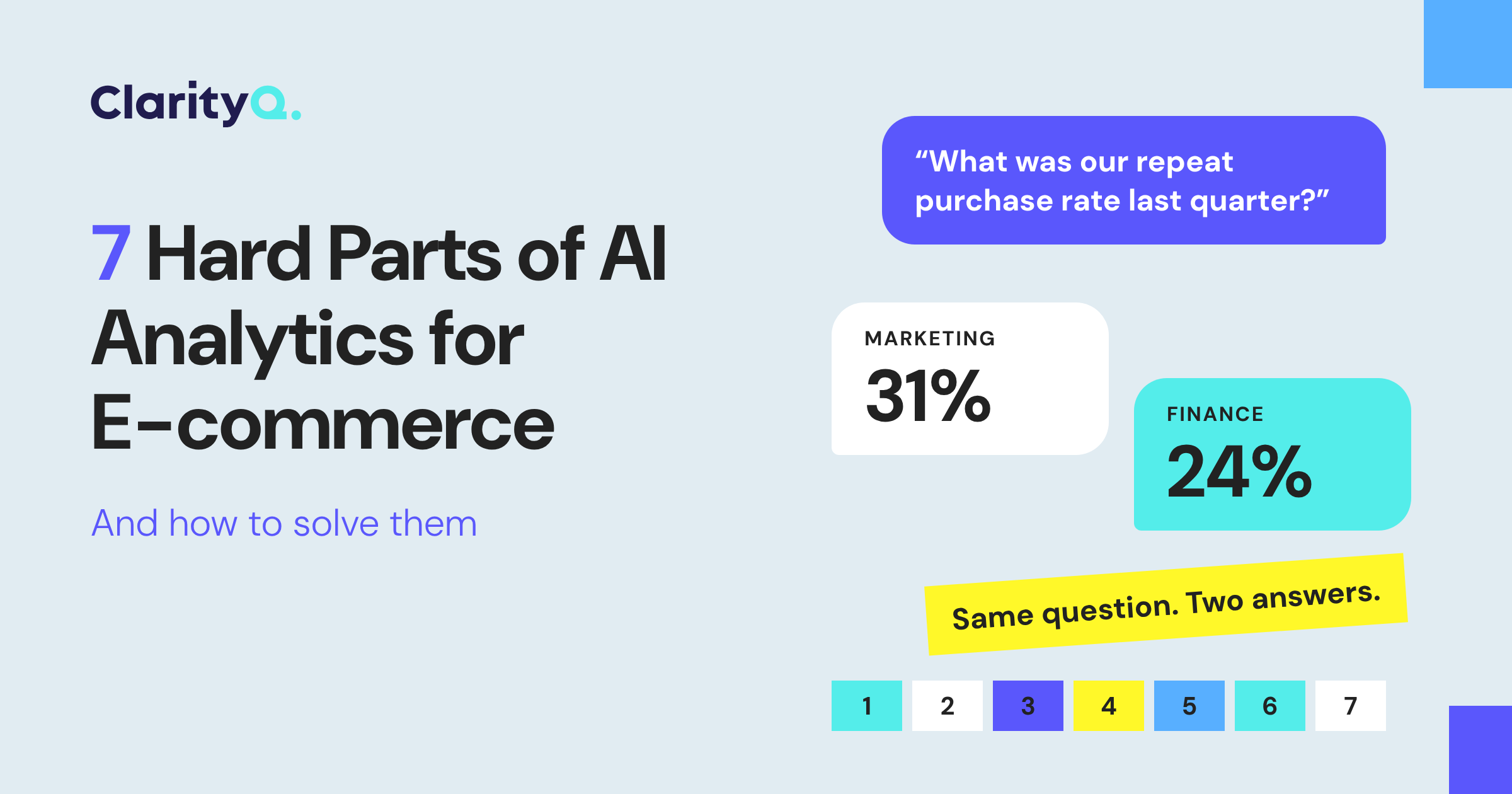
AI made asking questions about your store's data almost free. Anyone on the team can type "what was our repeat purchase rate last quarter?" and get an answer in seconds.
The hard part is what comes after. Two teams get two different numbers. Accuracy drops a month after launch. A wrong number lands in the Monday deck and nobody notices.
None of this is anyone's fault. AI tools simply don't come knowing your business. We work with e-commerce data teams every day, and the same seven challenges come up again and again.
They all come down to one thing: accuracy. If the business can't trust the answers, nothing else matters. And getting to high accuracy raises three practical challenges: consistency, maintenance and confidence. For each of the seven hard parts below, we explain what goes wrong, why it happens, and what the fix looks like.
I'm going deeper into all seven in a free 45-minute live workshop on November 18 at 12:00 ET / 18:00 CET. Save your spot.
An answer is only accurate if it's the same answer every time, no matter who asks or how they phrase it.
Marketing asks for last quarter's repeat purchase rate and gets 31%, because the AI counted any second order. Finance asks the exact same question and gets 24%, because this time it left out returned orders. Both answers are defensible. After the second one, the business stops trusting every number, even the right ones.
Why it happens: your tables don't say what "repeat customer", "net revenue" or "new customer" means at your brand. So the AI guesses, and it can guess differently each time.
The fix, in short: define each core metric once, in one place the AI reads before it writes any SQL, and make every answer use that definition.
When answers are off, it's natural to wait for the next model or try another tool. But the model is rarely the problem. Anthropic shared that their own analytics agent scored 21% accuracy without business context, and consistently above 95% with it. Same model. The only thing that changed was the context.
Why it happens: no model can know that your brand reports wholesale separately, or that Black Friday week distorts every comparison. That knowledge lives in your team's heads.
The fix, in short: build a context layer that sits between your warehouse and every answer. It holds what each table and column really means, one definition per metric, guardrails like "always exclude test orders", skills for answering recurring questions, memory of business facts and team conventions, and the events behind your funnels. See what goes into a context layer.
Even a perfect context layer loses accuracy if nobody keeps it up to date as the business and the data change.
You launch, accuracy looks great, and a few weeks later the answers start to slip. Nothing broke loudly. The tables, names and definitions just changed underneath.
Why it happens: in e-commerce, the data changes every week. A new Shopify app adds tables. Marketing renames discount codes. Finance changes how revenue is calculated. A context layer with no upkeep is a snapshot, and snapshots age.
The fix, in short: treat the context as a living product with an owner and a routine, not a project you finish.
The careful approach is to document and check the whole warehouse before anyone asks the AI a question. Weeks go by, the business is still waiting, and by the time it's done, new data has already landed.
Why it happens: it feels safer to be complete than to be fast. But a warehouse never stops changing, so "complete" never arrives.
The fix, in short: stop waiting for perfect. There's a faster way to bring in new data that keeps the analyst focused only where it matters. I'll walk through it step by step in the live workshop.
Someone fixes the revenue definition for one report, and three dashboards break. Or a new rule quietly contradicts an old one, and the AI picks whichever it finds first.
Why it happens: the context gets edited like a shared doc, not like code. There's no draft, no test, no record of what changed.
The fix, in short: treat changes to the context the way engineers treat code. In the workshop, I'll show what that looks like in practice.

Accuracy also means knowing when an answer can be trusted, and when it can't.
You ask "what was our revenue last month?" and get "$1.24M, up 12%". No caveats, no doubt. Underneath, the AI counted test orders and staff discounts as revenue, and the real number was closer to $1.08M. Nothing looked wrong, so it went straight into the board deck.
This isn't rare. In Workiva's 2026 executive survey of more than 2,200 finance, risk and reporting professionals, 84% said they were confident in the accuracy of AI outputs. Yet 26% said internal audits had caught AI errors that already reached the board or external audiences.
Why it happens: AI tools sound equally confident when they're right and when they're guessing. A wrong answer that looks right is worse than no answer, because nobody checks it.
The fix, in short: every answer should show what it relied on - which definitions, which rules - and flag anything that was unverified or improvised. Guardrails like "always exclude test orders" should be written down, not remembered.
People ask the AI questions every day. Some answers get a thumbs-down, some get corrected in the chat, and then the correction is buried in one conversation and the same mistake happens next week.
Why it happens: teams maintain the context on a schedule, not based on what people actually ask. The best signal about what's missing goes unused.
The fix, in short: turn everyday usage into your maintenance plan. How to do that is one of the things we'll cover in the workshop.
All seven come from the same place: the AI doesn't know your business, and nobody owns keeping it up to date. The good news is that this is fixable. A context layer that stays consistent, maintained and trustworthy is what gets you to high accuracy, and as an analyst, you're the person best placed to build it.
On November 18 at 12:00 ET / 18:00 CET, I'm running a free 45-minute live workshop for e-commerce data teams, where I'll go deeper into each of these:
Bring your hardest question, and your team. I'd love to see you there.
Register for free - The Hard Parts of AI Analytics for E-commerce
I'm Head of Analytics at ClarityQ, an agentic data analytics platform. The workshop is tool-agnostic: what you learn works whatever stack you use.